Lookalike Watch
Every new website, as it appears
We read every new security certificate and the daily lists of newly registered website names, and compare each one with your names, your products and your suppliers' addresses.
Running now

How it works
One engine runs everything Sixth does, for organisations and for people. It watches for fakes, AI decides what's real, a person approves anything that leaves Sixth, and every change is tested before it goes live.
Running now works today. Pilot we're building with our founding clients. Planned comes after the pilot.
The engine
Each card names the part of Sixth that does it. Every part and its price.
To show the padlock, a fake website needs a security certificate. Every certificate is recorded in public lists.
Lookalike Watch
We read every new security certificate and the daily lists of newly registered website names, and compare each one with your names, your products and your suppliers' addresses.
Running now
Scam Check
People forward the emails and texts they're unsure about to Scam Check. Any new fake link in one goes straight onto the watch list.
Running now
Inbox Watch
AI will check each new email in a company's Google Workspace or Microsoft 365 and move the scams out of the inbox. Every scam sender and link it finds will be watched and blocked for every client.
Pilot Watch-only trials
Social and app watch
AI will read new social media profiles and app store listings and score how closely each one copies you.
Pilot
Rules and AI do the sorting. We look at suspect pages but never touch them.
Lookalike Watch
We open each lookalike in a sealed-off browser in the cloud and take a screenshot. We never sign in, type or submit anything.
Running now
Scam Check
AI checks who really sent it, where its links go and what it asks you to do, then answers. See how Scam Check decides.
Running now
Lookalike Watch
AI sets real copies of you apart from businesses with similar names and from empty addresses nobody is using yet. Your team only sees the fakes.
Running now
AI agents do the repetitive work. A person approves anything we send outside Sixth, which takes about a minute.
Scam Check
Scam, genuine or marketing, with the reasons in plain English and what to check yourself next time.
Running now
Lookalike Watch
Your firewall, DNS filter or web proxy fetches the list of your confirmed fakes from a private link, as plain web addresses, CSV or JSON.
Running now
Lookalike Watch
You get an email for each confirmed fake, with the screenshot, the reasons and the evidence pack as a PDF.
Running now
Takedowns
Each request goes to the company hosting the fake and the one that registered its address, with the screenshot and where the page sends what people type. If the fake is still up two days later, we follow up.
Running now
Takedowns
Hosts and registrars answer at abuse@sixth.watch. AI reads each reply, matches it to its case and drafts any answer for a person to send. When a host says the fake is gone, we check straight away.
Running now
Payment Watch
AI will flag a new payee or changed bank details, and we will phone the supplier on a number we already trust before you pay.
Pilot
What was found, when, and what was done about it.
Lookalike Watch
Every lookalike is kept with the date we first saw it and what its page showed.
Running now
Evidence pack
Screenshots, dates, who runs the site, what its code does, the AI's reasons, every request we sent and how long the fake took to come down.
Running now
Monthly record
On the 1st of each month we email you a PDF of what we found, who we asked to remove it and how long each fake stayed up, ready for your board or regulator. It's built for the Scams Prevention Framework codes, which start no earlier than 31 March 2027.
Running now
The Sixth console
Each case is laid out so a person can decide it in about two minutes. Our analysts work in the console every day. Your people sign in to see only your own confirmed fakes, with their evidence and progress. On self-serve plans your team will decide cases too.
Running now our analysts' console Running now logins for your team Pilot self-serve
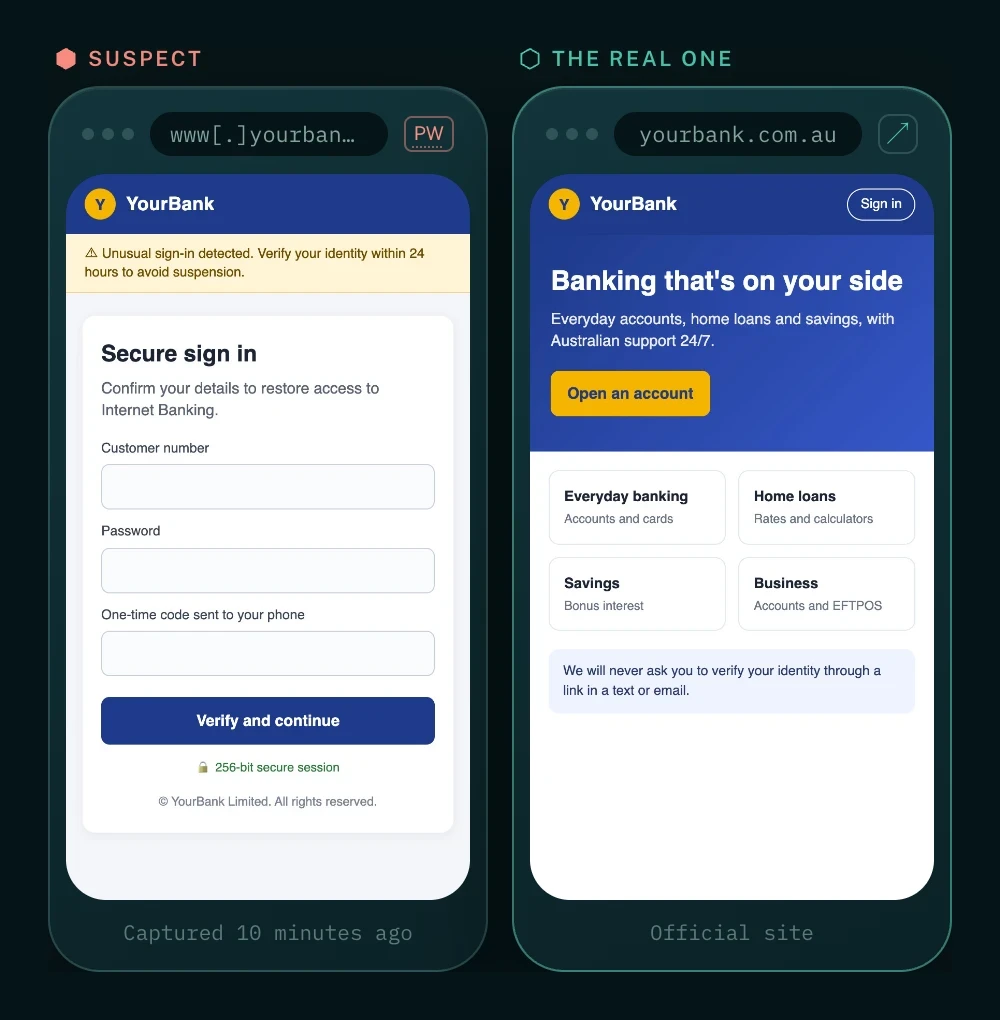
![A case in the Sixth console: a made-up YourBank sign-in page on yourbank-secure-login[.]com beside YourBank's real site, with the AI's verdict, Phishing at 94% confidence, and the steps it took.](/console/case.webp)
Every case opens with a one-line summary, then the fake page next to the brand's real site, both photographed by our own browser in the cloud. Most cases are clear within seconds. We keep every picture we take of a case. If one comes out blank, the case says so and shows what the page asks visitors to type, such as a password, a card number or a one-time code.
Running now
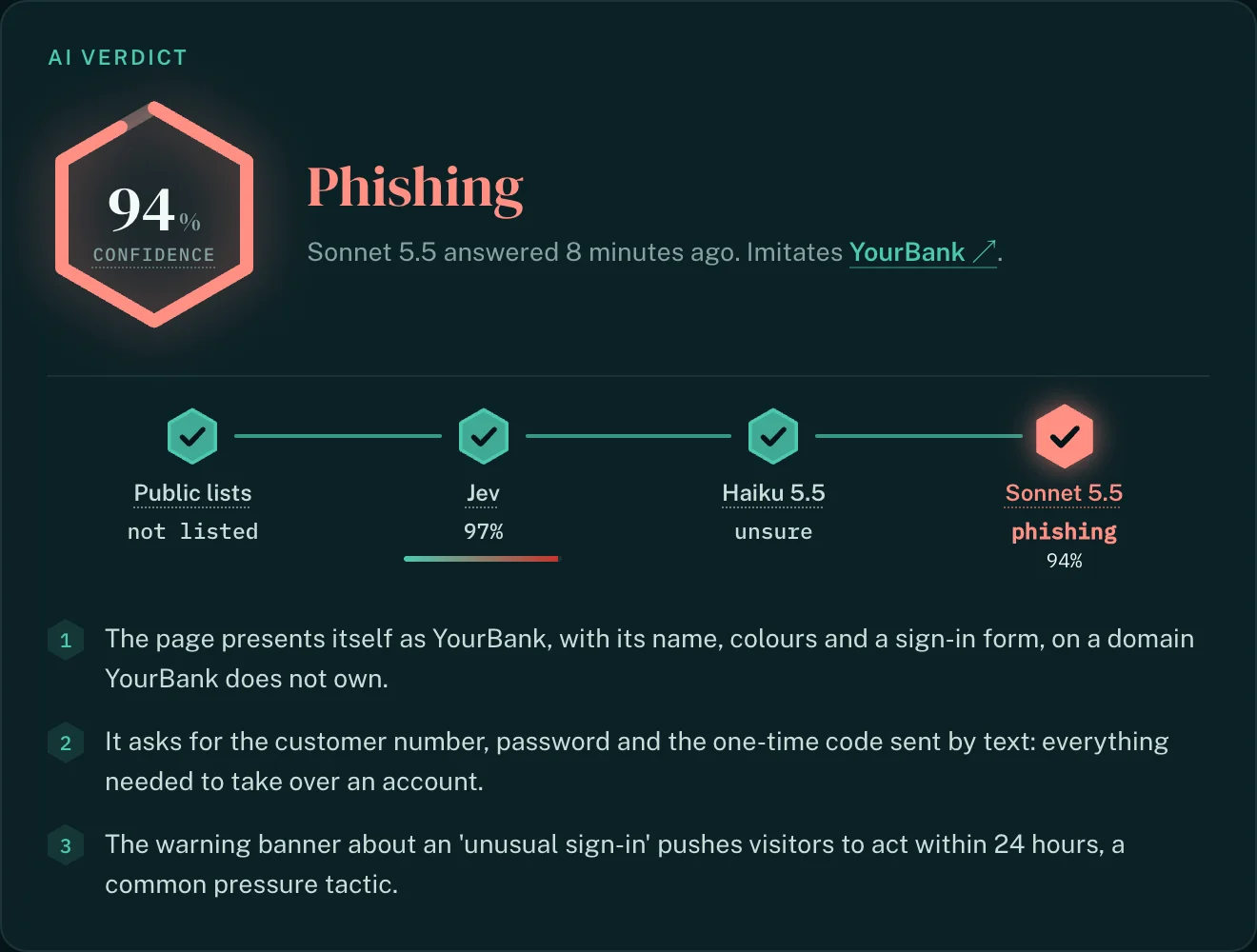
The cheapest check goes first: public phishing lists, then our own model, then larger AI models that also read the screenshot. Before any model, our checker reads the page's code: where its forms send what people type, files it copies from the real brand's site, and who runs the website it sits on. You see what each step found, how sure the last one was and why.
Running now
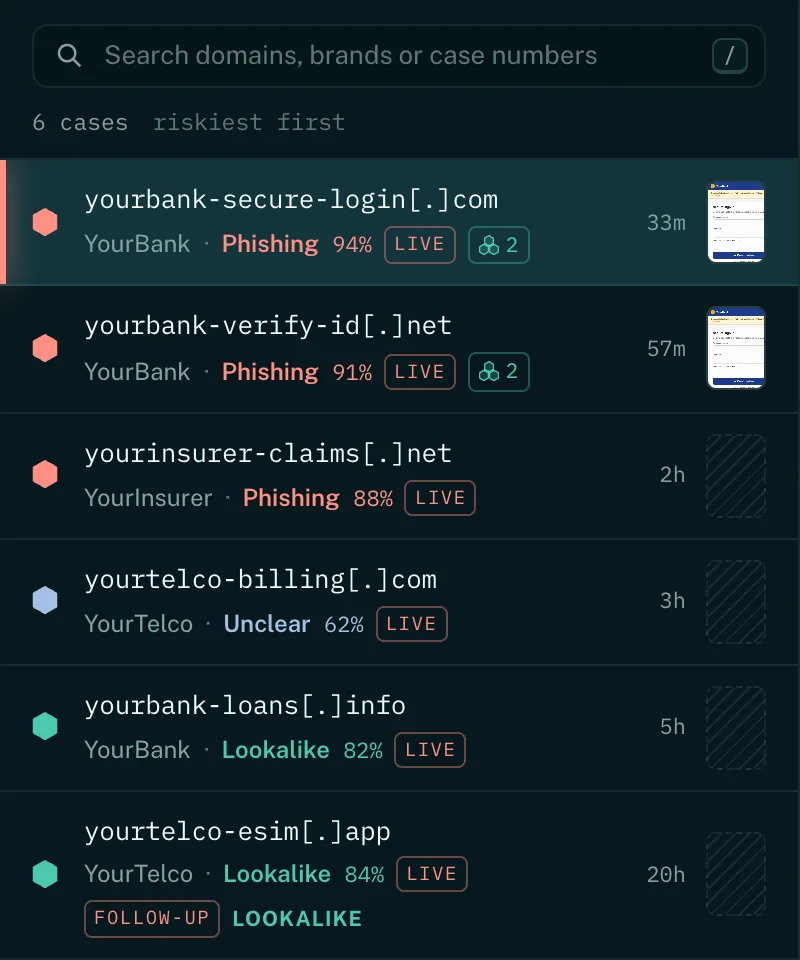
Live phishing sits at the top of the queue. Cases that look like one operator, on the same server with the same page, are grouped so they can be decided in one go.
Running now
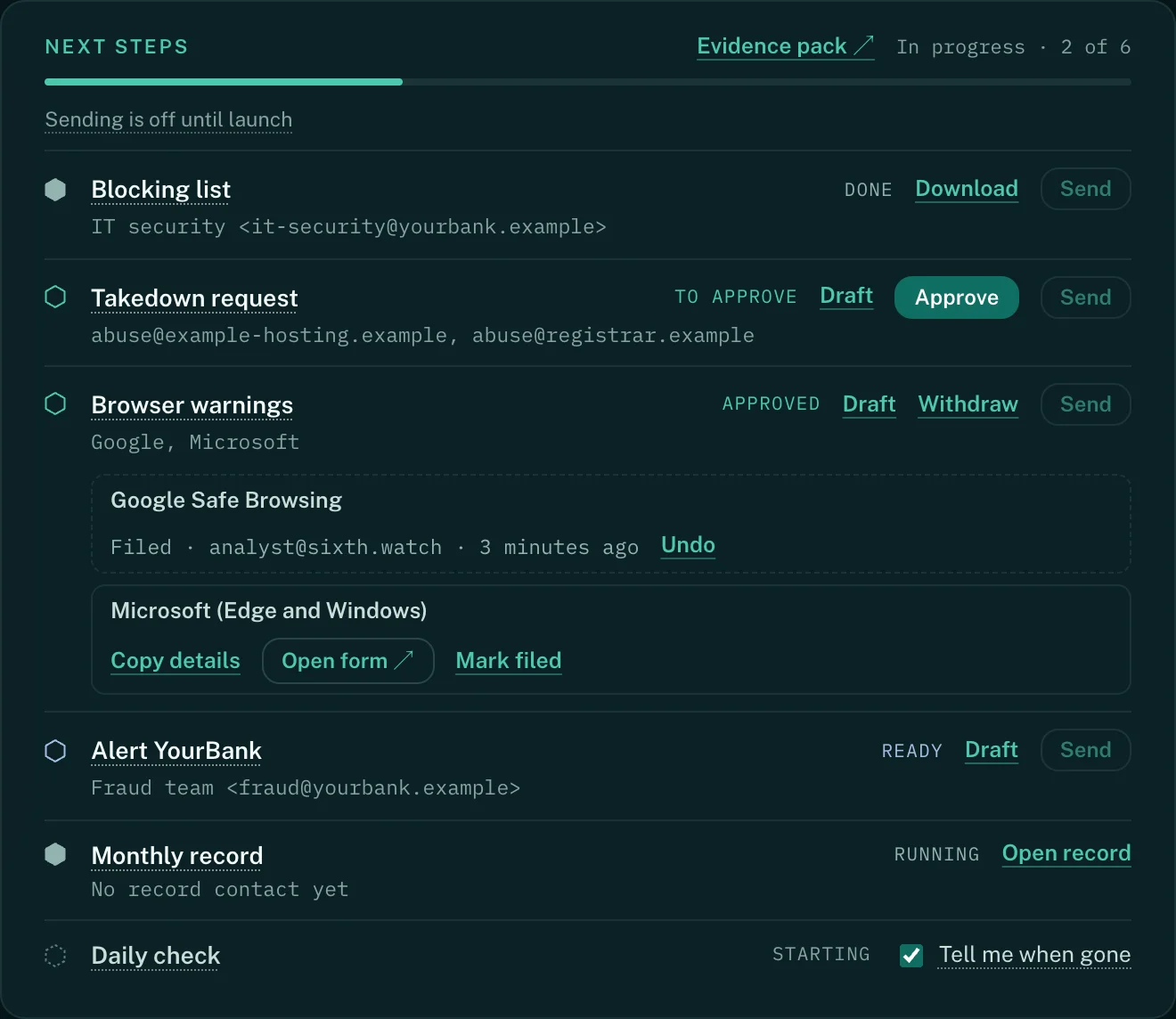
After a decision, each step gets one line in the order that matters: who it goes to and one word for where it stands. A progress bar ends at complete once the site is gone. The blocking list updates at once. Takedown requests and browser reports wait for a person's approval, then go out in Sixth's name. Every case has an evidence pack you can save as a PDF.
Running now
When a lookalike sets up email or a page goes live, or a closed case's evidence changes, the case comes back with a follow-up. Confirmed fakes are checked again every day until they're gone, and every hour while a takedown request is out.
Running now
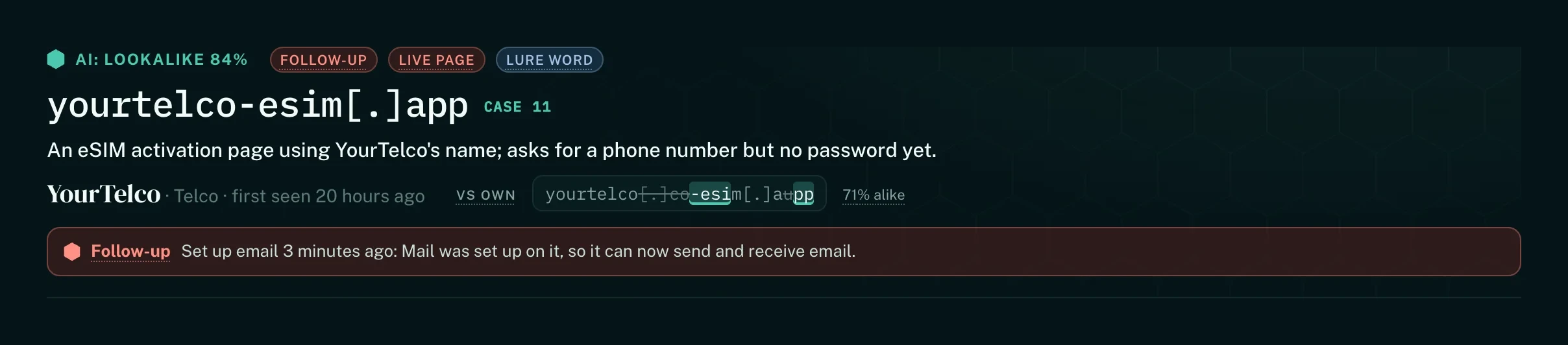
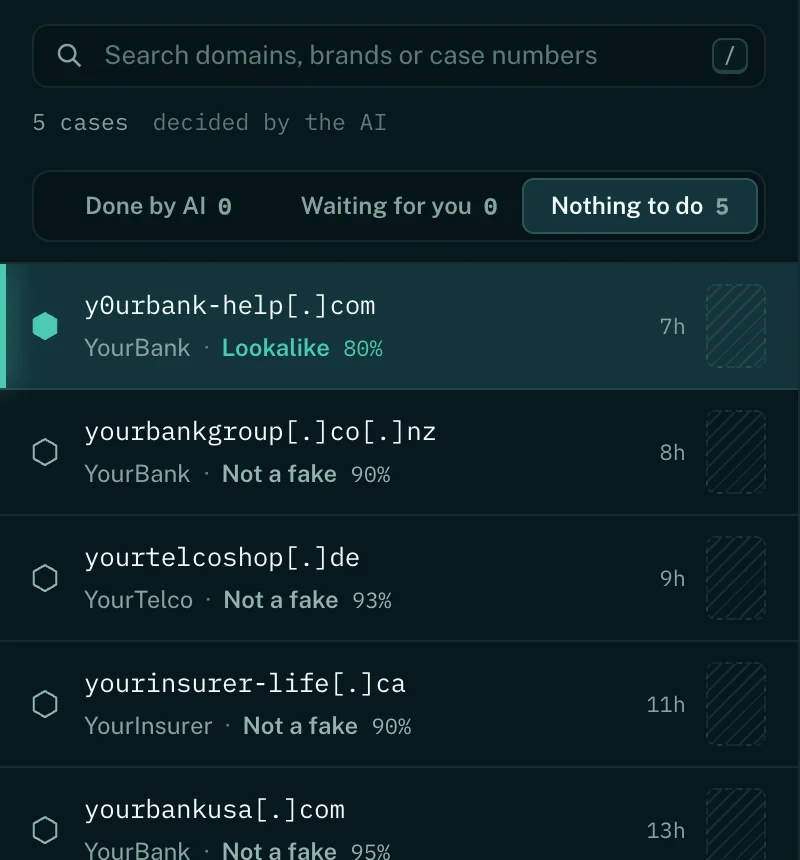
The AI closes namesakes and lookalikes with nothing live, and keeps them in their own list. Of the cases it closes while their page is live, one in five goes back to a person as a spot check. The AI only takes on more by itself once those checks show it's right.
Running now
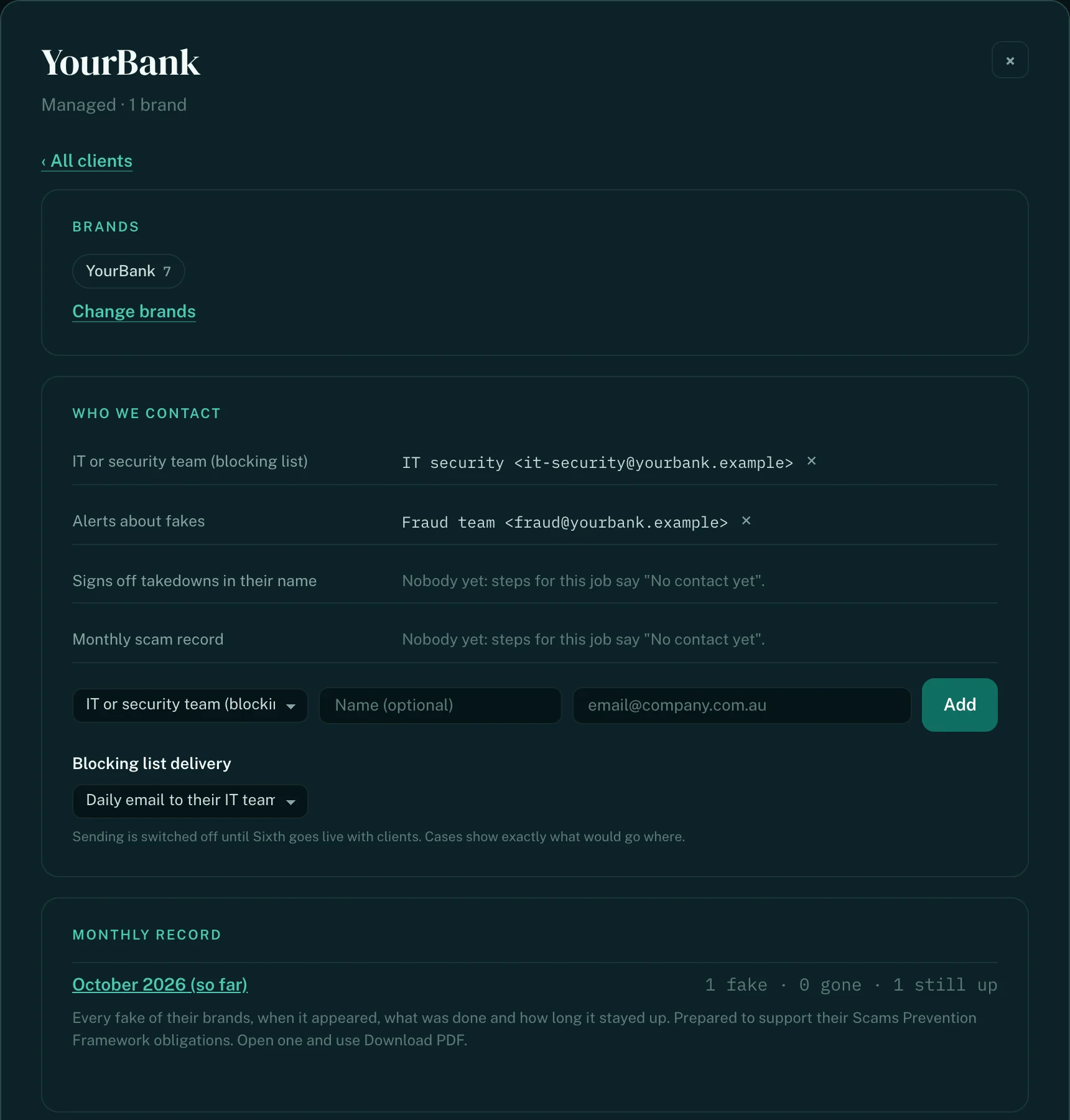
Each client keeps a contact for each job: the IT team for the blocking list, who to alert, who signs off takedowns. Roles decide who can look and who can decide.
Running now Pilot
Example only. YourBank, YourTelco and every case shown are made up.
How Scam Check decides
Every message goes through up to six steps. A step only gives an answer when it's sure. Anything still in doubt moves on to the next, more careful step. Most checks are settled in the first two steps, which keeps answers fast and costs low. Running now Lookalike websites go through the same kind of steps.
Who really sent the message, and can their address prove it? Where does each link really go, once tracking links are opened up? How old is each website? Does a link belong to the email service the sender uses? Is it on a public list of known scam sites, or one of the lookalikes Sixth has already caught?
A fast, low-cost AI model reads the message alongside the facts and answers five questions. Who does it claim to be? What does it ask for? Does it pressure you? What kind of message is it? Is it a scam? It can only call something a scam on its own when the facts back it up.
Say a message claims to be from your bank or the tax office, but comes from somewhere else and asks you to act. That's impersonation, whatever else it says. If the sender proves its address and links only to its own sites, it's genuine.
Anything still in doubt goes to a more capable AI model. It weighs the facts the way a security expert would, and writes the explanation you read.
For the hardest cases, we open the doubtful link in a sealed-off browser in the cloud, take a screenshot and show it to our most capable AI model. We never click, type or submit anything on the page. If the email looks like a genuine account email, we remove any personal codes from the link first.
Every reply asks you to tell us if we got something wrong. We read each correction and add it to the emails we test every change on.
AI you can check
On lookalike websites, the AI agrees with our reviewers on 95.5% of a test set of 157 decided cases, and it dismissed none of the 25 real fakes in it (October 2026). People's decisions go back in: when someone marks a domain as not a fake, the AI remembers that organisation's other domains.
We keep a set of real emails, each one already read and marked scam, genuine or marketing. It includes scams collected by security researchers, scams sent to our team, and genuine bills, bank notices and account emails. Before any change to how Sixth decides goes live, it has to pass two tests on that set:
In our latest test (October 2026) Scam Check answered 98.8% of 492 test emails correctly and caught 157 of 157 scams. On the 130 emails it had never seen, it scored 100.0%. These figures update after every full test.
Boundaries
Organisations start with a Sixth account and the parts they need. People start with a free Scam Check.